About

Randy Krum infographic designerRandy Krum

President of InfoNewt.
Data Visualization, Infographic Design, Visual Thinking, Product Development and Marketing professional fascinated by good infographics.  Always looking for better ways to get the point across.

Infographic Design


InfoNewt Infographic Design

Search the Cool Infographics site

Custom Search


Subscriptions:


Feedburner

The Cool Infographics Gallery:

How to add the
Cool Infographics button to your:

Cool Infographics iOS icon

- iPhone
- iPad
- iPod Touch


Read on Flipboard for iPad and iPhone

Featured in the Tech & Science category

Flipboard icon

Twitter Feed
Caffeine Poster

The Caffeine Poster infographic

Google Insights

Entries in auto (28)

Monday
Apr092012

CSR and Sustainability Report: Volvo Shaping the Future of Transport

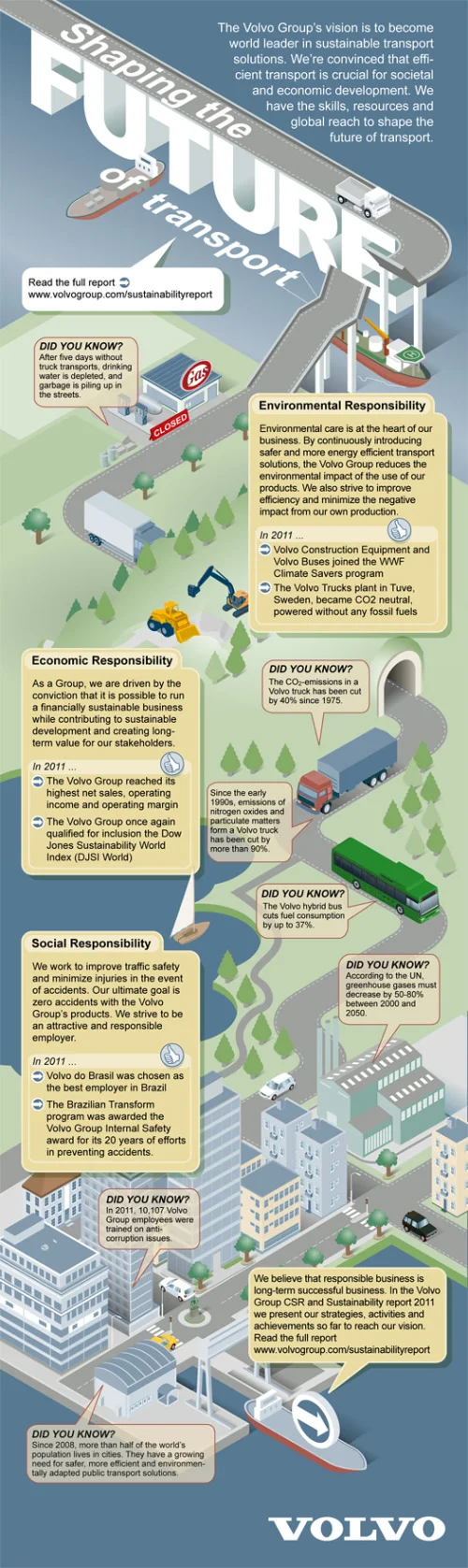
Volvo’s new infographic puts their 2011 CSR (Corporate Social Responsibility) and Sustainability Report into a tidy, easy to read design! Shaping the Future of Transport focuses on Volvo’s environmental, economic, and social responsibility.

All you need to know about the Volvo Group’ CSR and Sustainability Report 2011.

The Volvo Group’s vision is to become world leader in sustainable transport solutions.  We’re convinced that efficient transport is crucial for societal and economic development.  We have the skills, resources and global reach to shape the future of transport.

This is a fantastic use of an infographic as a corporate communication tool.  Volvo is using this infographic as an awareness tool to put their Sustainability Report in front of more readers and broaden the awareness of their efforts.  It’s designed as a top-level overview, and if the reader wants more information, they know how to find the full report.

The illustrations obviously represent the varied forms of transport that Volvo is involved in, and my only criticism is that the design is mostly text.  They list locations, percentages, company historical events and other statistics about Volvo that should all be data visualizations.  At they bottom, they should include the URL to the original landing page, and a copyright statement.

On the original landing page, the whole infographic is a link to their online Sustainability Report front page, but it would have been nice for them to use an HTML Image Map to make the separate statistics and call-outs link to the specific, related web pages in the report.

Thanks to Gustaf for sending in the link!

Tuesday
Mar272012

Seven Motorcycle Safety Tips

The Seven Motorcycle Safety Tips infographic comes to us from Bisnar|Chase. This infographic gives some helpful tips on saftey to prevent injuries, but if you do have an accident, they’d like to help!

Motorcycle safety is no joking matter. Please take your safety seriously. If you do become injured in a motorcycle accident we would like to help. Contact us immediately to schedule your free consultation with our reputable California motorcycle accident lawyers.

A couple things I really like about this design.

  • It tells a simple, easy-to-understand story
  • Clean design, not too much visual noise
  • Good illustrations to illustrate each safety tip and statistic
  • Each of the values included are visualized to make them quick and easily to read

The data source is listed in the infographic, but it’s missing a copyright statement and a URL to the original infographic posting at the bottom.  The page with the original posting is also missing sharing buttons for social media, so it’s difficult for readers to share the infographic.

Thanks to Chris for sending in the link!

Friday
Mar022012

The Genealogy of Automobile Companies 

A brand new infographic poster designed by Larry Gormley at HistoryShots.comThe Genealogy of U.S. Automobile Companies visualizes over 100 years or corporate history of car company mergers, acquisitions and closures.

A flowing history of more than 100 automobile companies across the complete time span of the automobile industry. From 1900 to 1925 over 3,300 organizations were formed to produce automobiles in the United States. In 1910 alone 400 new startups entered the industry. Most attempts lasted less than two years. While car sales exploded (from 1910 to 2010 US sales rose from 200,000 to 11.5 million cars) the strongest entrepreneurs bought out rivals and combined forces. Today, ten companies account for about 90% of all US automobile sales.

This graphic uncovers and explains how the industry was created and how it arrived at its present form. At the core is a full genealogy of over 100 companies from the Big Five to the small defunct companies. Folded into the genealogy is the relative market share of US sales for each company.

The Big Five car companies have unique colors, and all of the other companies are color-coded into categories of he trest of the Top 20, defunct companies and other interesting or famous companies.  The thickness of the lines change over time to represent market share.

You can buy a copy of the 38” x 23” poster for $29.95 over at HistoryShots.com

Thanks to Larry for sending in the link!  Great design!

Wednesday
Jan112012

Calendar Visualization of Fatal Car Crashes

I really like this data visualization from Nathan Yau at FlowingData.comVehicles Involved in Fatal Crashes 2010 takes a new look at the statistics released by the U.S. National Highway Traffic Safety Administration.  Instead of plotting them on a traditional map, Nathan looked at the time data.

After seeing this map on The Guardian, I was curious about what other data was available from the National Highway Traffic Safety Association. It turns out there’s a lot and it’s relatively easy to access via FTP. What’s most surprising is that it’s detailed and fairly complete, with columns for weather, number of people involved, date and time of accidents, and a lot more.

The above shows vehicles involved in fatal crashes in 2010 (which is different from number of crashes or number of fatalities). This data was just released last month, at the end of 2011 oddly enough. It’s a calendar view with months stacked on top of one another and darker days indicate more vehicles involved.

- Nathan Yau

As was suggested by others in the comments on FlowingData, I agree that since the weekends have the higher incidence rate, starting the week with Monday and moving Sunday to the last column may show that a little bit clearer.

Nathan has made all of the data avaialble for anyone that would like to try a visualization themselves.  Student project?

Wednesday
Nov022011

Client Infographic: Look Both Ways Before You Cross


Pedestrain Deaths in Southern New Jersey takes an infographic look at some usually inacessible and hard-to-find data from the different state department websites.  Console & Hollawell worked with InfoNewt and designer Nancy Gage to bring the data together into one infographic that tells a more complete story.

The New Jersey personal injury lawyers at Console & Hollawell receive calls on a daily basis from the unfortunate victims of car accidents across New Jersey and Pennsylvania. We are actively pursuing lawsuits in several cases. In an effort to bring attention to these dangers in New Jersey, we created the infographic below to help bring these statistics to light and ultimately help pedestrians maintain more awareness when crossing these dangerous New Jersey streets.

Although child deaths while crossing the street are the events that get the big headlines in the news, I was surprised that only 4 of the 157 deaths were kids.

Thursday
Jul142011

Distracted Driving Infographic

Distracted Driving Statistics
[Source: Christensen Law Firm]

From the Christensen Law Firm in Utah comes the Cell Phones & Driving infographic that looks at the horrifying statisitics behind accidents and deaths caused by people using cell phones while driving in the U.S.

shocking facts about the realities of texting and driving in modern culture. It mentions, for example, that 18% of all fatal accidents are caused by cell phone use, and that 6 collisions occur every 10 minutes because of cell phones. In other words, keep the cell phone as far away from you as possible while driving, because frankly, becoming one these statistics is not an admirable achievement.

The design style is very crowded and busy, but I like the unique approach to using each number on the keypad as a statisitic.

“More than one in four Americans who download apps admit to using those apps while driving.”  On my iPhone, one of those apps is the TomTom GPS app, so of course I use it while driving!

Thanks to Jake for sending in the link!


Monday
Jun202011

Drunk Driving by the Numbers


The Real Effects of Drinking and Driving is a good infographic from CarInsuranceComparison.org.  It stays focused and tells one compelling story really well.  Some of the illustrations are just that, illustrations, when they could have visualized the numbers.

Thanks to Clyde for sending in the link!

Friday
Jun102011

White House Infographic: The Resurgence of the American Automotive Industry


The team at the White House released The Resurgence of the American Automotive Industry infographic on the White House Blog last week in conjunction with President Obama’s visit to Toledo, OH and the JEEP manufacturing plant there.

Today, President Obama will travel to Toledo, Ohio where he will visit the Chrysler Group’s Toledo Supplier Park – an operation that employs more than 1,700 workers producing Jeep Wranglers, Jeep Liberties, and Dodge Nitros.  Just two years ago, Chrysler was filing for bankruptcy, and President Obama made the tough decision to support the restructuring of the company rather than allow it to fail – which would have cost tens of thousands of American jobs.

Today, Chrysler is repaying its government loans six years ahead of schedule and posted five consecutive quarters of operating profit.  Earlier this week, the National Economic Council released a new report on the resurgence of the American automotive industry.  Over the past two years, the auto industry has added 113,000 jobs - the fastest pace of job growth in the auto industry since 1998.

Check out this infographic that highlights some of the key successes in the auto industry since 2009.

I wrote a long critique of the last White House infographic about Obama’s Energy Plan (The Obama Energy Agenda: The White House attempts an #Infographic).  This one improves on some of the design issues I had with the last one.  I like that the White house is being consistent with the design style, and you can tell at a glance that this one is obviously in the family of official infographics from the White House.

Citing sources is still an issue for these infographics from the White House.  There are two sources cited and referenced, but many more statistics are included without any source.  For example, where does the “39% increase in exports of vehicles and parts to China” come from?  There are many statistics that could have been visualized to reduce the amount of text as well.  Listing a bunch of numbers in bold text doesn’t make for a good infographic design.

I love the inclusion of the Jeep photo with information mapped on top.  Much more interesting and engaging to the reader than what could have been a list of 17 suppliers, and more interesting than plotting them on a map of the U.S.

The timeline is pretty boring.  The dotted line could have been tire tracks, and way too much text that could have been data visualizations.

Thanks to Mary Kaye for sending me the link!

Friday
May202011

Expert Driving Techniques #infographic

Here’s a good one to start the weekend.  From imingle.com comes Expert Driving Techniques That Could Save Your Life.

This has got to be one of the longest infographics I’ve seen, so I shrunk it down a little bit to post here.  I know my readers like to see the whole infographics when I post them, but you can see the full-size version here.

Not many statistics or data visualizations, but really good driving advice and some good illustrations to make them easier to understand.  Some of the illustrations (like braking methods) look like data visualizations, but there’s no data behind them

Thanks to Brittany for sending in the link!

Monday
Jan102011

The (Visual) Evolution of the Batmobile


This is a really TALL infographic, but fun to read through nevertheless.  The Evolution of the Batmobile from Carinsurance.org (I wish they would credit the designer) is a visual timeline in the form of a comic book page looking at many (I’m sure they missed some, but not many) versions of the Batmobile from 1941 to 2010.  They also cover different versions from comics, television, movies, ads, posters and computer games.

The Batmobile has always been the trademark vehicle for Batman. However, throughout the history of the comic, the Batmobile has undergone some changes to its design and gadgets. Here’s an overview of some of the evolutions of the Batmobile.