About

Randy Krum infographic designerRandy Krum

President of InfoNewt.
Data Visualization, Infographic Design, Visual Thinking, Product Development and Marketing professional fascinated by good infographics.  Always looking for better ways to get the point across.

Infographic Design


InfoNewt Infographic Design

Search the Cool Infographics site

Custom Search


Subscriptions:


Feedburner

The Cool Infographics Gallery:

How to add the
Cool Infographics button to your:

Cool Infographics iOS icon

- iPhone
- iPad
- iPod Touch


Read on Flipboard for iPad and iPhone

Featured in the Tech & Science category

Flipboard icon

Twitter Feed
Caffeine Poster

The Caffeine Poster infographic

Google Insights

Entries in shopping (4)

Friday
Feb222013

Top 250 Internet Retailers Q3 2012 Update

Top 250 Internet Retailers Q3 2012 Update infographic

Top 250 Internet Retailers Q3 2012 Update infographic from the Campalyst blog

Back in May we published an infographic about Top 250 Internet Retailers’ presence on social media. The infographic was perceived really well by our readers, customers and the media; thanks a lot to all the people sharing it on Facebook, Twitter, Pinterest and their blogs!

Now we are happy to present you with the Q3 update! Spoiler: those were two incredible quarters for Pinterest! Amazing growth in terms of the number of brands building their presence on Pinterest and the size of their communities!

I like the color scheme and the variety of data visualizations used in this infographic.  Bars, icons, arcs and proportional circles.  The use of the Internet retailer logos in the circles is especially effective.

I wish the Social Media site logos had been used, especially in the first three sections.  I shouldn’t have to read the text and match the color to figure out what the visualization represents.  That’s too much work for the reader.  How many people does each of the people icons represent in the “How Many Followers Do They Have?” section?  The lines look “relatively right”, but the number of icons seems to have no relationship to the actual numbers shown.

The footer needs both a copyright statement (or Creative Commons license) and the infographic landing page URL so readers can find the original when they see this posted on other sites (like this one!).  Many bloggers are not good about linking back to your original site correctly, and you want your audience to be able to find it easily.

Found on Fresh Peel and Visual Loop


Wednesday
Oct312012

60th Anniversary of the Bar Code

60th Anniversary of the Bar Code infographic

Wow!  This year is the 60th Anniversary of the Bar Code, and I remember when checkout clerks at the grocery store had to key in every price!  OK, I only barely remember that as a kid.

The barcode is a fundamental part of how we obtain goods—from scanning items for price comparisons, adding goods to a wish lists and checking out purchased products. We use barcode scanners on a daily basis, but have you ever asked yourself how the barcode came to be? Would you believe that the first barcode was printed on a pack of Wrigley’s gum, and originally created to help grocery stores track inventory? 

Today is the 60th Anniversary of the barcode; and if you’re interested in learning more fun facts like the ones above as well as how the barcode came to be, its practical uses, and how industries have implemented the technology today, check out the infographic below.

Even without any data visualizations, this design does a good job of leading the readers through a short history, and visually shows the reader the different types of bar code technologies and bar readers.

In the footer, the design is missing both a copyright statement, and a URL to help the readers find the original full-size version on Wasp Bar Code’s landing page.  They include the home page URL, but a reader won’t find any mention of the infographic on the home page.

Thanks to David for sending in the link!

Wednesday
Jun132012

The Value of Retail-Integrated eCommerce

The Value of Retail-Integrated eCommerce

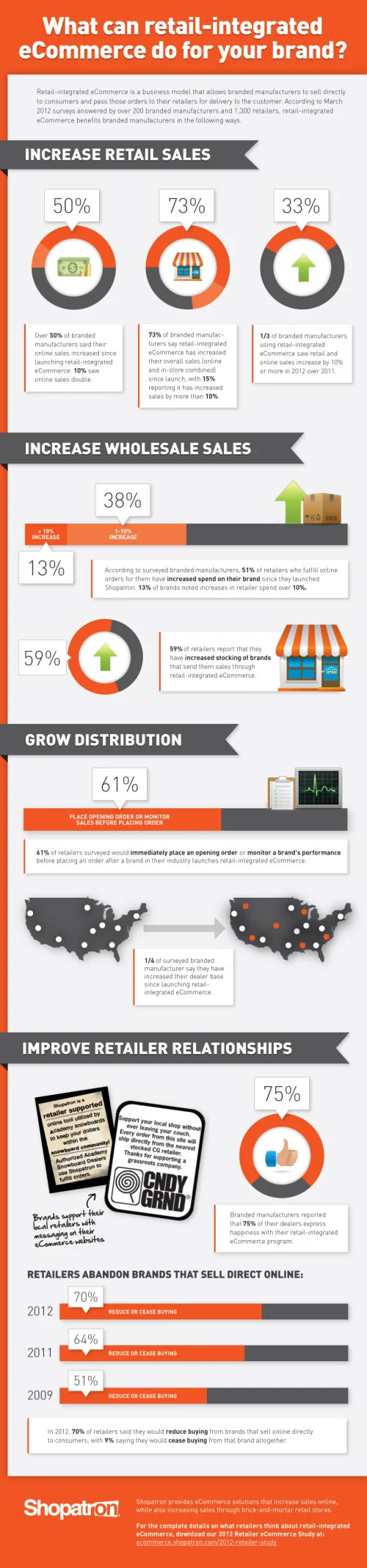
What can Retail-Integrated eCommerce do for your brand? is a new infographic based on a research study from Shopatron.  

Retail-integrated eCommerce is a business model that allows branded manufacturers to sell directly to consumers and pass those orders to their retailers for delivery to the customer. According to March 2012 surveys answered by over 200 branded manufacturers and 1,300 retailers, retail-integrated eCommerce benefits branded manufacturers in the following ways.

This is obviously a design for a niche audience, but I can tell you from past experience that Branded eCommerce is a HUGE challenge.  A company makes products for the end user; however, their immediate customers are usually retail stores.  As soon as a product company starts trying to sell their products on their own website (cutting out the retail store), they suddenly become a competitor to all of the existing retail store customers.  The idea of Retail-Integrated eCommerce is a potential solution.

The statistics at the bottom of the infographic that explain this challenge (not visualized) are so important, I think they should have been visualized and highlighted at the top of the design.  This is the background information that makes the rest of the infographic relevant.

In 2012, 70% of retailers said they would reduce buying from brands that sell online directly to consumers, with 9% saying they would cease buying from that brand altogether.

This is a good design that doesn’t try to throw too much information at the reader.  Most of the important data points are clearly visualized with short descriptions.  The orange color scheme clearly identify the design with the Shopatron brand.

You can also download the PDF version here.

Tuesday
Nov222011

Crazy for Black Friday Deals


In honor of our upcoming shopping holiday, Crazy for Black Friday Deals from BradsDeals takes a look at some of the stats behind Black Friday (day after Thanksgiving) shoppers.

BradsDeals created a Crazy for Black Friday Deals infographic to illustrate historical Black Friday figures as well as the shopping trends and predictions for this year’s holiday.

If you live in Minnesota, congratulations, you live in the most Black Friday crazy state in the country. And while Black Friday fans in major cities like New York, Los Angeles and Chicago may be more likely to cruise Black Friday deals on their smart phones than shoppers in smaller towns, the Dallas suburb of Carrollton blows everyone out of the water with 60% of Black Friday searches happening on mobile devices. WOW.

I live near Carrollton, but I wouldn’t consider it a particularly tech-savvy area.  Apparently, they’re good with mobile shopping…who knew?

Of course, I get tons of Black Friday infographics submitted to the site, but I really liked the design of this one.  The information is visualized in a clear, easy-to-understand design. The visuals are simple and relate to the data.  Maps for cities, calendar for days shppers make plans, doughnut diagrams for percentages and silhouettes of top products.

On the other hand, there doesn’t seem to be a cohesive story to this infographic.  It’s a collection of disconnected data points about top cities, mobile trends, top products and when shoppers make plans.  Also, the design is missing a list of the data sources, the URL for readers to find the original posting, a copyright or creative commons claim and recognition of the designer.  Why should we trust any of these statistics?

Thanks to Amanda for sending in the link!