About

Randy Krum

President of InfoNewt.
Data Visualization, Infographic Design, Visual Thinking, Product Development and Marketing professional fascinated by good infographics.  Always looking for better ways to get the point across.


Like us on Facebook to help spread the word!

Click +1 to give us your stamp of approval or just to say “this is pretty cool.”

Infographic Design


Search the Cool Infographics site

Custom Search

Design Contest!

Infographic Design Contest!

Enter to win an iPad 2!

Subscriptions:


How to add the
Cool Infographics button to your:

- iPhone
- iPad
- iPod Touch


Read on Flipboard for iPad and iPhone

Featured in the Tech & Science category

Strata Conference 2012

Follow Me!


Follow Randy (@rtkrum) 

Blog posts ONLY on Twitter

Twitter List: Cool Infographics People

Twitter Feed
Political Party Posters
2012 Death & Taxes Poster

Cool Affiliates

OmniGraffle

OmniGraffle for Mac - The Omni Group


Pixelmator

Pixelmator - Pixelmator Team


MindNode Pro

MindNode Pro - Markus Müller


 Skitch

Skitch - Skitch


GraphicConverter

GraphicConverter - Lemke Software GmbH


Visit Art.com


From the Bookstore

Caffeine Poster

Gadget Map

Google Insights

Infographics Carousel
Thanks to...
Powered by Squarespace


Entries in color (21)

Tuesday
Jan312012

The Psychology of Color

The Psychology of Color is a cool infographic from CertaPro Painters of Louisville.

This new infographic from CertaPro Painters of Louisville shows how color evokes emotion and triggers your senses. It beautifully explores colors that should and should not be used in interior decorating, as well as why certain colors are used in advertising.

Designed by NowSourcing.com, I love the visual appeal of this design.  Obviously, it’s bright and colorful, but in all three sections of the layout (home, colors and advertising) they provide visual examples to back up their observations about different colors. I would love to have a house that colorful!

There is much more information on this subject, but this design also kept the information fairly simple and straightforward.  The colors make the design very “busy”, but the design doesn’t try to communicate too much information to the reader.

The design is missing the URL to find the original landing page, and a copyright statement.  I also found it odd that they needed to clarify that M&Ms are “an American Chocolate Candy”.  Aren’t M&Ms an international brand?

Thanks to Jay for sending in the link!  Also found on Infographic Journal.

Monday
Aug152011

The Crayon-Bow, Crayola Color Chart updated

I’m not sure how I missed this, but the designer know as Velociraptor has updated his original Crayola Color Timeline that I posted about last year, into the the new Crayon-Bow (half rainbow - half rising sun).

The original was a square, straightforward representation, but the colors in the later years were shown in very small slices are hard to see.

A number of other visual layouts were tried, but the arc style visual not only allowed the colors from the later years to be easier to see, but the original eight colors pointing inwards look like the tips of brand new crayons as well.

I love the new version.  Found on Twitter: @printmag, @wired, @awaaza

Monday
Mar142011

Moviebarcodes: Whole Movies at a Single Glance

Moviebarcodes is a tumblr blog from an unknown author that posts these images generated from different movies.  Each frame of the movie is stretched tall and thin to create this single image from an entire movie.  The one above is from The Matrix, and you can see the green tint they used every time they were “in the Matrix”.

From Wired:

The person behind MovieBarcode, who wouldn’t reveal their identity or what they do for a living, told Wired.co.uk that the creative process can take a few hours on the slightly aged machine they are being processed on, “depending on the length of the movie and the quality of the outcome”.

Movies on the blog are chosen “due to the expected result, not for the movies themselves”. Besides colourful movies, the blog author prefers “movies with long shots such as Kubrick, Hitchcock and Weerasethakul, which can result in unique and interesting moviebarcodes”.

Although, some of them don’t seem to reveal anything interesting, a few of these did give some insights into the movie visuals.

They spent a lot of time at sea in Jaws:


The Dark Knight was a very dark, almost colorless movie:


Kung Fu Panda was very colorful:


You can see the time spent in the digital, neon-blue world of TRON (1982):


Found on Wired.co.uk, VisualJournalism, FlowingData and Chart Porn.

Thursday
Sep162010

The Most Powerful Colors on the Web


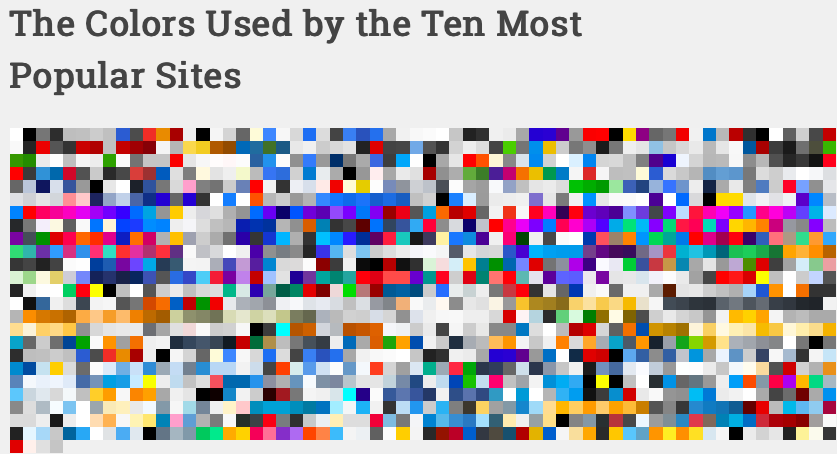
The Colors of the Web is a very cool infographic by ColourLovers.com.  Looking at the color distribution of the icons of the top 100 web brands.

When we released our report on the colors of the social web, based on data analyzed by our Twitter theme tool, we were surprised that blue was such a dominant color in people’s profile designs. Was Twitter’s default color influencing their design decisions? Or is blue really THE most popular and dominant color online? …We decided to look at the colors in the brands from the top 100 sites in the world to see if we could paint a more colorful picture.

Maybe a yellow icon wasn’t the best choice I’ve ever made…

Friday
Jun112010

The Color Strata, a beautiful color naming infographic

Stephen Von Worley at WeatherSealed.com has taken the data made public from XKCD’s Color Name Survey and created a very cool infographic, The Color Strata.  Check out the high-resolution version.

The Color Strata includes the 200 most common color names (excluding black-white-grayish tones), organized by hue horizontally and relative usage vertically, stacked by overall popularity, shaded representatively, and labeled where possible.  Besides filtering spam, ignoring cruft, normalizing grey to gray, and correcting the most egregious misspellings (here’s looking at you, fuchsia), the results are otherwise unadulterated.  As such, similar color names, like sea green, seafoam green, and seafoam, each appear separately.  They’re synonymous… or are they?

Also check out the smoothed version:

It’s the same basic graph, but with flipped shading, label-free, stretched to fill the vertical, and whipped until creamy smooth.

The volunteer survey have over 200,00 respondents that named over 5,000,000 color samples.  Here’s the original image created by XKCD.com when they posted the data.

Found on ChartPorn.org and FlowingData.com

Tuesday
Apr272010

The Color of Twitter

I really like The Color of Twitter from InfoChimps.org that plots the background colors used by all 40 million of the Twitter.com users.  I do think the infographic would be better if they had actually extended out the default light blue color instead of just noting that it extends 4.8x longer.  They also don’t account for background images that cover the background color, which would account for a large number of people not changing their colors.

As part of the release of a number of new, free Twitter data sets, Infochimps created the following beautiful infographic showing just what color Twitter really is.

The data for the infographic comes from the just-launched Histograms dataset that aggregates anonymous data about Twitter users such as how many users have x number of friends or followers, or how many users are in x location. The company also released new data sets (paid) about stock tickers, hashtags and URLs on Twitter.

Found on Mashable.com

Tuesday
Feb092010

The Crayola Color Timeline, 1935-2010

From WeatherSealed.com, the visual timeline of Crayola crayon colors.

Ever industrious, Velo also calculated the average growth rate: 2.56% annually.  For maximum understandability, he reformulated it as “Crayola’s Law,” which states:

The number of colors doubles every 28 years!

Found on ChartPorn


Friday
Jul032009

Graphical History of the American Flag


A great infographic for America’s Independence Day from Mike Wirth.  The graphical history of the American Flag shows a circular timeline of when changes were made over the years and when stars were added.  I love additional information Mike included like the official folding pattern and the state each star represents by showing them chronologically.  Makes a great poster!


Tuesday
Jun162009

The Conversation Prism 2.0 has been released!


Check out the new version of The Conversation Prism 2.0 by JESS3 and Brian Solis and theconversationprism.com.  Available as a poster for $20 US on thier website, and they also have some high-resolution versions available.

I love the design of this one.  It's seems to be essentially a mind map, but much easier to read and understand.

This is an update to the original Conversation Prism that you can see here on Flickr.

Thanks Dana!  I found the link to the 1.0 version on ON:Digital+Marketing

Friday
May222009

The Amazon Book Map


Now this is impressive.  Chris Harrison has created the Amazon Book Map using data scraped from Amazon and which books Amazon thinks are related to each other.
Aaron Swartz, who runs theinfo.org, contacted me back in January '08 with an interesting data set. He had built a list of 735,323 books by crawling Amazon. Of course a gigantic list is pretty boring, but Aaron had also captured similarity data between books. In particular, he had amassed a whopping 10,316,775 connections (edges) between books Amazon believed were related. This allowed me to throw the data into my old wikiviz engine to spatially layout a huge mosaic of books (I let it run for a 140 hours). Items that were noted as being similar had attractive forces, bringing them together, often into large groups. Unsurprisingly, when we color coded by Amazon book category, there was an obvious coalescence. The way various high-level categorizations mix and meet also seems fairly logical.
I produced a few versions of what I am dubbing the Amazon Book Map. The first visualization is a huge mosaic of book covers, tinted by their respective category colors. I can't produce this in one go at full resolution because the memory requires are enormous. The second version uses color-coded dots. 
As you zoom into the image, you can see its built using the book cover images with a color overlay depicting the category of the book.


Thanks to @anniesmidt on Twitter for the link to this one!