About

Randy Krum

President of InfoNewt.
Data Visualization, Infographic Design, Visual Thinking, Product Development and Marketing professional fascinated by good infographics.  Always looking for better ways to get the point across.


Like us on Facebook to help spread the word!

Click +1 to give us your stamp of approval or just to say “this is pretty cool.”

Infographic Design


Search the Cool Infographics site

Custom Search

Design Contest!

Infographic Design Contest!

Enter to win an iPad 2!

Subscriptions:


How to add the
Cool Infographics button to your:

- iPhone
- iPad
- iPod Touch


Read on Flipboard for iPad and iPhone

Featured in the Tech & Science category

Strata Conference 2012

Follow Me!


Follow Randy (@rtkrum) 

Blog posts ONLY on Twitter

Twitter List: Cool Infographics People

Twitter Feed
Political Party Posters
2012 Death & Taxes Poster

Cool Affiliates

OmniGraffle

OmniGraffle for Mac - The Omni Group


Pixelmator

Pixelmator - Pixelmator Team


MindNode Pro

MindNode Pro - Markus Müller


 Skitch

Skitch - Skitch


GraphicConverter

GraphicConverter - Lemke Software GmbH


Visit Art.com


From the Bookstore

Caffeine Poster

Gadget Map

Google Insights

Infographics Carousel
Thanks to...
Powered by Squarespace


Entries in social (33)

Tuesday
Dec132011

Social Media Stats of the Day


This is a LONG one, but a good one based on statistics recently published in AdAge.  Social Media Stats of the Day from Dream Systems Media visualizes some fo the recent stats about Favebook Twitter and general Social Media usage.

Saw an article on Social Media stats the other day on AdAge by Sarah Evans (awesome list of stats she compiled) and of course, me being who I am, I wanted to visualize the data. So enjoy! I used several of these statistics in my recent SMX Social Media Scottsdale presentation on SoLoMo – Checking into the real world.

- Mat Siltala

I really like the coloring in this design that visually ties the data to the Facebook and Twitter brands instantly for the readers.  Although, big fonts don’t make a data visualization, and a number of percentages included could easily have been visualized as simple pie charts or stacked bar charts.  I do think there is too much text in the design, but I can appreciate how specific you have to be when describing the research data and where it came from.

Nice job Mat!

Tuesday
Nov012011

The Life Cycle of a Web Page on StumbleUpon


StumbleUpon.com has shared a number of the differetn stats behind it’s social sharing service in the infographic The Life Cycle of a Web Page on StumbleUpon.  Designed by Column Five Media, the infographic focuses on the half-life of a link and the length of time users view pages and interact with StumbleUpon.  This information shows that the half-life of a StumbleUpon link is much longer than other social media sites that were shared by bit.ly in September.

You may have heard the stat that StumbleUpon drives more traffic referrals than any other social media site. We wanted to shed some light on this by describing the lifecycle of a web page in StumbleUpon, especially how long you could expect the average web page to keep getting visitors.

StumbleUpon doesn’t get as many mentions in the media as Facebook and Twitter, but the data indicates that they have more referrals than those two combined.  I see that here on the Cool Infographics blog occassionally.  When one of my posts is picked up in StumbleUpon is usually gets thousands of stumbles.

Found on Visual News and Fast Company Design.

Thursday
Oct202011

The Socially Optimized Business


Attributes of a Socially Optimized Business is a new, visual XPLANATION from the Dachis Group after acquiring the XPLANE company.  You can view it in SlideShare (they should have put it into Prezi), or download the high-resolution PDF.

What’s a Social Business? It’s a business alive with energy and big ideas. It’s collaborative, authentic, customer-centric, trusted, open and real-time.

And it’s about time. After decades of mechanistic, process-oriented management dogma, progressive organizations are waking up to the disturbing truth that they’ve squeezed all the creativity out of their business. But when companies embrace organic, passionate, socially-savvy initiatives, they blossom. That’s Social Business.

This would make a great poster!

Tuesday
Oct042011

Social Media Usage in the UK

Social Media Usage in the UK is a new infographic from Umpf.co.uk

We then analysed the results to bring what we believe is the most up-to-date snapshot of social media usage in the UK.  If you like statistics, you can view them all here.

Our infographic, created by Vapour, helps visualise statistics; it outlines the gender and age differences in social media usage.

It needs a title.

I love that they included a link to the data file in GoogleDocs in the original posting.

I like the idea of the Man/Woman stacked percentages.  Although, I’m guessing they didn’t calculate the icon shape areas to get the section sizes right, which makes the visualization false.  They probably just calculated the height of each section, which visually misinterprets the data.  YouTube is shown to be much bigger than it really is because the shape is widest there.

They don’t need the Key/Legend at the bottom (“Legends are Evil”).  The social media icons were clearly used in the first bar chart, and could have been included in them all for clarity.  Build the data right into the charts, and you don’t need a legend.

At the bottom should be a copyright (or creative commons license), the URL to the original infographic, the Umpf company logo,  the sources listed and the designer credit.  Once this infographic is posted elsewhere on the Internet (like here on the Cool Infographics blog) all of the information that was included in the original posting is lost.  (unless a good blog author, like me, includes the links)

Thanks to Jon for sending in the link!

Thursday
Sep292011

Airlines: The Future of Loyalty is Social


SimpliFlying has done some great research on how frequent travelers use social media.  The Future of Loyalty is Social infographic summarizes some of the key findings from the research.

To dig deeper, we partnered with Cranfield University in the UK to conduct a study on how frequent travelers (who travel at least five times a year) use social media. And here are some highlights of what we found:

  1. There are more airlines on Twitter than there are airlines with frequent flyer programs (191 vs 179)
  2. Almost 90% of frequent flyers use Facebook regularly, and over 65% “Like” at least one airline on Facebook
  3. To frequent fliers cheapest fare is the least significant loyalty factor among customer service, earning loyalty points and onboard experience
  4. 72% of frequent fliers would join a social loyalty program
  5. Over 65% of frequent fliers would like to earn social loyalty points via check-ins or by contributing ideas to an airline’s Facebook page.
  6. Over 80% of frequent fliers would like to earn social loyalty points by recommending the airline to a friend or providing positive feedback.

In the infographic below, we have summarized the findings of the study, and will soon release a detailed presentation of these findings too. Special thanks to Gavin Tan and Prof. Keith Mason from Cranfield University for their tremendous help with this study.


The simple, isotype-style illustrations are immediately recognizable since they are so similar to the figures used in airports and airline signage.  I think the Frequent Flier Participation Ladder is some fantastic data, and should have been more prominent in the design.

A handful of things I would have changed about the design:

  • The initial visualization of social sites should have been in descending order.  It’s almost there except for Twitter listed first.
  • The Twitter factoid ‘Frequent fliers “following” their favorite airlines on Twitter are steadily increasing’ is not supported by the visual showing how many airlines are followed by frequent fliers.  The statement claims a change over time.
  • The benefit percentages are shown on an odd shape of 10 squares.  Is that supposed to be an airline seat?  Hard for the reader to visually grasp the percentage since it isn’t a simple square shape.  A grid of 100 squares would have worked better.
  • The doughnut percentages are sorted in descending order, so the colors are in a different order in each doughnut.  Very hard to interpret.  The orders should have stayed consistent from Very Strong to Not at all in each doughnut.  Doughnuts are also hard to compare with each other visually.

Some great research data, and an infographic was a great way to publicize it.  They were very thankful to the professors at Cranfield University for their help with the research, but I wish they had credited a designer.  Was this done by someone inside SimpliFlying?

Found on MediaBistro

Wednesday
Jul272011

The VIZoSPHERE - Visualizing DataViz People on Twitter

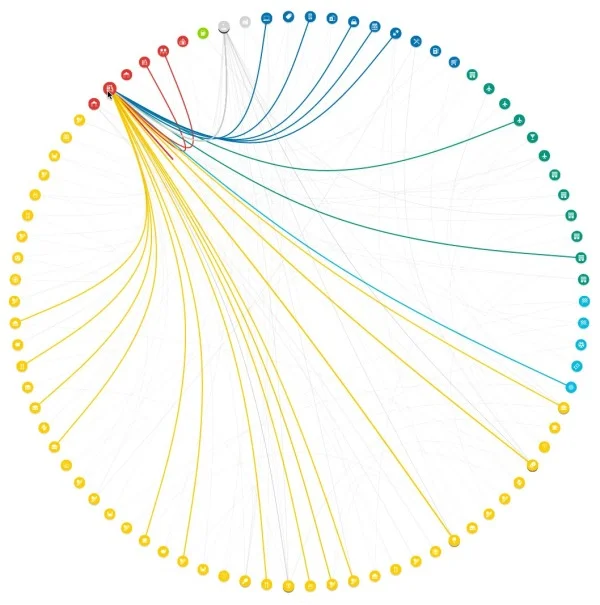
From Moritz Stefaner on Visualizing.org, comes the VIZoSPHERE project (Click the image to see the high-resolution image viewer).  Using GePhi, Moritz started with 18 seed accounts on Twitter, and then mapped 1,645 of the connected, networked accounts that relate to data visualization.  Bubble size in this visualization shows how many followers each account has from within this DataViz pool of users.

This map shows 1645 twitter accounts related to the topic of information visualization. The accounts were determined as follows: For a subjective selection of “seed accounts”[1], the twitter API was queried for followers and friends. In order to be included into the map, a user account needed to have at least 5 links (i.e. follow or being followed) to one of these accounts. The size of the network nodes indicates the number of followers within this network.


[1] The seed accounts were; @moritz_stefaner, @datavis, @infosthetics, @wiederkehr, @FILWD, @janwillemtulp, @visualisingdata, @jcukier, @mccandelish, @flowingdata, @mslima, @blprnt, @pitchinteractiv, @bestiario140, @eagereyes, @feltron, @stamen, @thewhyaxis

The zooming interface is crucial to view such a highly-detailed visualization and be able to read any of the nodes.  I was about to find my own Twitter account (@rtkrum), but it would be nice if Moritz would also provide a listing of the Twitter accounts or some way to search the map.

Great job Moritz!

Found on FlowingData and Robin Richards (@ripetungi) on Twitter.

Wednesday
Jul132011

The Content Grid v2

First, The Content Grid v2 is a cool, new infographic collaboration between Eloqua and JESS3.  The infographic maps out the different ways that companies can deliver information to potential customers, how that content can effect the buying process and the different distribution channels for that information.

It’s a complex set of data, and this infographic does a fantastic job of summarizing the different tools available onto one page.  This would work as a fantastic tool to use when planning a strategy to release a new product, and choosing the different ways you could successfully reach your customers.

The Content Grid v2 picks up where its predecessor left off. Intact is the prescriptive connection between content type and distribution channel. New is the perspective of the buyer, a multi-stage purchase funnel, and a comprehensive collection of KPIs (like they say, “What isn’t measured, isn’t purchased.”). Although v2 contains significantly more information than the original, the new design is infinitely more simple. This achievement is a tribute to the unrivaled design team at JESS3 – and the clarity of client/agency communication that comes only with time and trust.

Enjoy The Content Grid v2. It’s not only the next generation of the Web’s most popular and award-winning content marketing infographic, but it’s also a how-to for marketers looking to operationalize content marketing programs.

Second, Jesse Thomas, CEO of JESS3, has posted a good “The Making of an Infographic” article on Forbes.com looking behind the scenes at the infographic design process, and sharing some of the other design options that were explored during the process.  A couple of the other designs are included above.


And finally, third, Joe Chernov has a good article about designing Planned Obsolescence into the infographic as an effective markleting practice.  Eloqua and JESS3 released the original Content Grid (above) in June of 2010 knowing it was interesting data, but not quite useful yet as a tool.

We knew the graphic was interesting visually, and we also knew it could be used by marketers. But deep down we felt that something was “off,” but we couldn’t quite put our finger on what was wrong. We could have sat in the drawing room until it was “perfect” (translation: indefinitely), but we didn’t. Instead we published the content as-is and deliberately planned to revisit it one year later.

During that time, we solicited feedback (in blog comments, on Twitter, from colleagues, even from the audience at speaking engagements) and preserved all comments in a spreadsheet. By provoking widespread feedback (positive and negative), we were deliberately rendering obsolete the infographic we had worked so hard to develop.

A fascinating look at how infographics are made and used as effective marketing tools.

Monday
Jul112011

Client Infographic: Facebook, Privacy and Health

For the Path of the Blue Eye Project, I recently designed the infographic: What You Need To Know: Facebook, Privacy and Health.  The group at the Path of the Blue Eye Project has done some fantastic, primary research about online users’ willingness and attitudes about sharing health information online, and specifically Facebook.

The answer is overwhelmingly “NO”.

If Facebook is so popular (Pew reports that 62% of Web users frequent sites like Facebook and MySpace), why are people shying away from sharing health content with others on the site?  To answer this question, the Path of the Blue Eye Project commissioned a national survey designed to tease out some of the reasons why Americans are reluctant to exchange health information on Facebook.  We found:

  • 68% of Facebook users have not and would not share their personal health information on the site. The most commonly cited reason for refusing to share: “it’s no one’s business but my own (86%).”
  • Privacy concerns may be one reason many refuse to share.  39% of non-sharers were afraid strangers would find their health information and 32% worried marketers might use it to sell products and services.

Online users do a lot of searching for health information, but very few are willing to share any of their own information on social sites like Facebook.

The Facebook Privacy Policy is huge, and most of the concerns why oline users are unwilling to share online information have to do with unintended people finding their information.  Insurance companies, marketers and strangers top the list of concerns.

Thanks again to Fard and the team at Enspektos.com.  There’s much more information available at the Path of the Blue Eye Project.

Tuesday
Jun212011

Foursquare Reaches 10 Million Users


Foursquare yesterday announced that they have reached 10 Million members, and released this infographic for the occasion.

And, to commemorate this pretty crazy occasion, we put together a little infographic. Be sure to click through to see it bigger; if you’re anything like us, watching the full-size animated map puts butterflies in your tummy. Thank you so much for supporting us!

I love the animated portion right in the middle!

Personally, I have mostly given up on Foursquare check-ins without the points or mayorships earning anything for me.  I wonder how many of those 10 Miliion joined, but don’t use Foursquare anymore?

Thursday
May052011

The Reality Behind Social Location Apps #infographic

Digital services company Beyond compiled the results of their research into location-based apps, and designed this infographic summarizing the results; Check-In Data: The Reality Behind the Hype.  Released in conjuction with the Social-Loco conference in San Francisco, CA on May 5th.

As part of our involvement in the Social-Loco conference we have done some research to try to understand the difference between what people are saying online compared to the actions of early adopters and the views of the rest of the US population when it comes to their mobile check-in habits.

The results give us a clear understanding of who the winners and losers are likely to be, as well as the types of things that will motivate the mass consumer to adopt location-based apps. They also highlight some of the real challenges there are to consumers embracing this technology.

The data is very interesting.  Personally, I continue to use Foursquare, but find myself checking in less and less because I don’t get any direct benefits out of it.

From a design standpoint, I like the circle clusters, but I don’t like data separate in a legend on the side.  I appreciate that the color-coding remains the same, so Twitter is the same color in each visualization.  I would have included the logo images for the social location-based apps, and connected the data directly to the circles.  Data legends like this make your readers work harder to understand the information.

I also think that the most interesting learning from the study is the comparison between how people interact with national brands and small, local businesses.  However, this is the last visualization at the bottom, and gets lost.

Found on Mashable!