About

Randy Krum

President of InfoNewt.
Data Visualization, Infographic Design, Visual Thinking, Product Development and Marketing professional fascinated by good infographics.  Always looking for better ways to get the point across.


Like us on Facebook to help spread the word!

Click +1 to give us your stamp of approval or just to say “this is pretty cool.”

Infographic Design


Search the Cool Infographics site

Custom Search

Design Contest!

Infographic Design Contest!

Enter to win an iPad 2!

Subscriptions:


How to add the
Cool Infographics button to your:

- iPhone
- iPad
- iPod Touch


Read on Flipboard for iPad and iPhone

Featured in the Tech & Science category

Strata Conference 2012

Follow Me!


Follow Randy (@rtkrum) 

Blog posts ONLY on Twitter

Twitter List: Cool Infographics People

Twitter Feed
Political Party Posters
2012 Death & Taxes Poster

Cool Affiliates

OmniGraffle

OmniGraffle for Mac - The Omni Group


Pixelmator

Pixelmator - Pixelmator Team


MindNode Pro

MindNode Pro - Markus Müller


 Skitch

Skitch - Skitch


GraphicConverter

GraphicConverter - Lemke Software GmbH


Visit Art.com


From the Bookstore

Caffeine Poster

Gadget Map

Google Insights

Infographics Carousel
Thanks to...
Powered by Squarespace


Entries in planets (21)

Wednesday
Jun092010

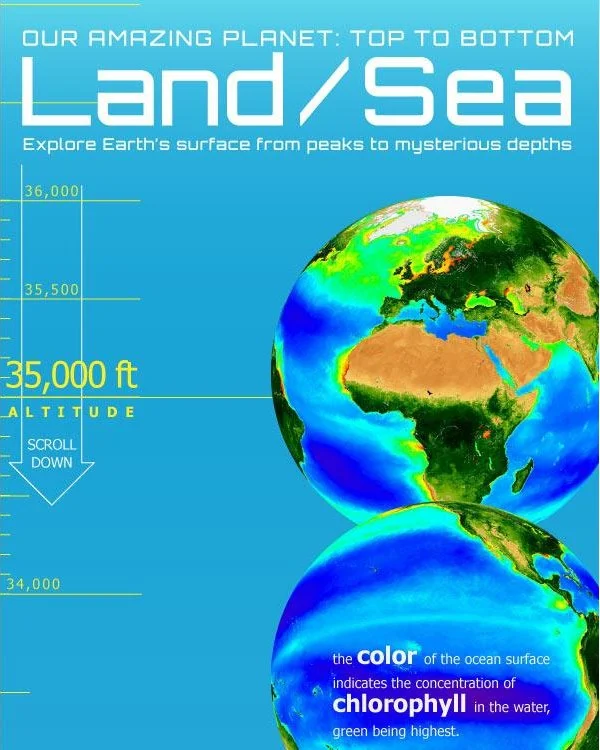
Our Amazing Planet: Top to Bottom infographic


Designed by Karl Tate, Our Amazing Planet: Top to Bottom is a cool infographic that looks at the scale of things from the upper atmosphere to the deepest ocean depths.


The infographic is HUGE (14,677 pixels tall), and that keeps it accurate to the scale.  It’s unreadable when the entire infographic is viewed on the screen, and that adds to the readers grasp of how big this scale really is.


It’s also timely with recent events, showing the depth of the Deepwater Horizon oil rig spill, and drilling depth.  You can view the entire image on OurAmazingPlanet.com.


Tuesday
Dec292009

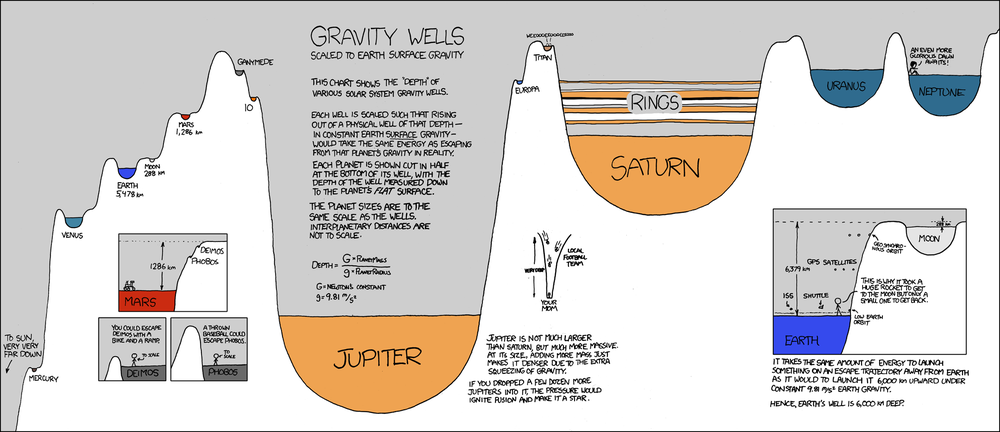
Visualizing Gravity Wells - infographic comic


Another great new infographic comic from xkcd.com.  A mix of real science and humor, this one plays on the words “gravity well” by visualizing the strength of each planets gravity as the depth of a crater scaled to Earth’s surface gravity.

The chart shows the “depth” of various solar system gravity wells.
Each well is scaled such that rising out of a physical well of that depth - in constant Earth surface gravity - would take the same energy as escaping that planet’s gravity in reality.

Click on the image to go to the xkcd.com site to see the high-resolution version.


Thanks for sending in the link Ruben!


Wednesday
Dec092009

Bill Nye Videos on the Scale of the Solar System

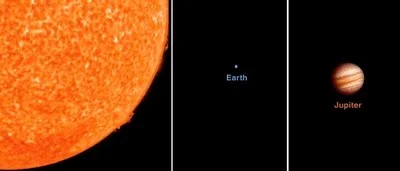
Two videos from Bill Nye the Science Guy showing the size and scale of the planets and the Sun.  He may have done similar examples, but these are the two I know about.  The one above (Planets & Moon) starts at about 4:00 into the video, and the one below (Outer Space) starts at about 2:00.  "Outer Space is HUGE!"

Thanks to @DannyDougherty on Twitter for sharing!

Monday
Dec072009

Scale Model of the Solar System


The Scale Model of the Solar System (from phrenopolis.com) shows both the relative sizes of the planets and the Sun as well as representing the distances from the Sun on the same scale.  This image is huge (just over half a mile wide), and as you can imagine mostly black.
This page shows a scale model of the solar system, shrunken down to the point where the Sun, normally more than eight hundred thousand miles across, is the size you see it here. The planets are shown in corresponding scale. Unlike most models, which are compressed for viewing convenience, the planets here are also shown at their true-to-scale average distances from the Sun. That makes this page rather large - on an ordinary 72 dpi monitor it's just over half a mile wide, making it possibly one of the largest pages on the web. This means you'll have to do a bit of scrolling if you want to find the planets, but don't despair. They are reasonably bright and labeled, so you can probably catch them flashing by in the blackness even if you are scrolling fairly fast.
Found on Information Aesthetics.

Monday
Nov232009

Probes in the Universe - cool interactive infographic


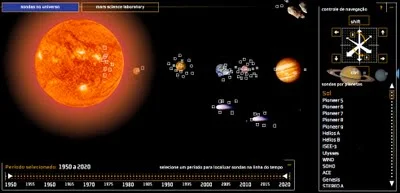
Space Probes is a very well-done interactive graphic about all of the space probes we have launched, visually placing the probes in orbit around the object they are observing.  You can move around the 3-D space with the keyboard controls, change the date range with the sliders on the bottom or go directly to a particular probe from the list on the right that is group by planet or object they are around.  When you mouse-over a particular probe you get more details and an image.


The article and the infographic are in Portuguese from Brazil, so I took the liberty of using the Google Translator for a little help.
The infographic "Space Probes" Super, produced by the team of Internet Editora Abril Jovem, took the silver medal in the category Online Malofiej, top prize in the world of computer graphics.
Thanks to Daniel for the link and a little more information:
It won Malofiej's silver medal (first place, no gold medal) this year. 
It's an infographic about all space probes launched until the date it was published (except Earth probes, which are too many). The info has information about each probe, including the organization(s) that sent it, the target planet(s) (or moons, asteroids, comets and the sun), launch date and mission details, as well as pictures for most of them. User can navigate through our Solar System using the mouse and/or keyboard. It's also possible to know the details of Mars Science Laboratory, the next NASA probe to visit the red planet. The info is in Portuguese, but anyone can understand it's features and learn a little bit about space exploration so far.

Tuesday
Oct132009

50 Years of Space Exploration - Visual Flight Map


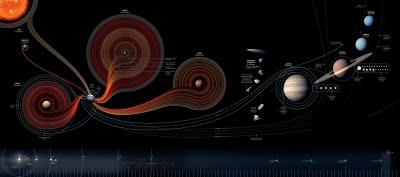
National Geographic published this amazing flight map that shows the flight paths of all 200 space missions in the last 50 years.  A zoomable map is on the NG website, and a high-res image is available from Adam Crowe on Flickr.

Art by Sean McNaughton, National Geographic Staff, Samuel Velasco, 5W Infographics.

Found on Fast Company.

Monday
Mar232009

Planets, a Solar System Visualizer


Check out Planets, an interactive solar system visualizer.  It lets you change the focal point so you can see the planetary motions as if you were standing on any of the planets.  A great way to understand retrograde motion.

Thanks Paul, for the link.

Tuesday
Feb242009

Space Debris video


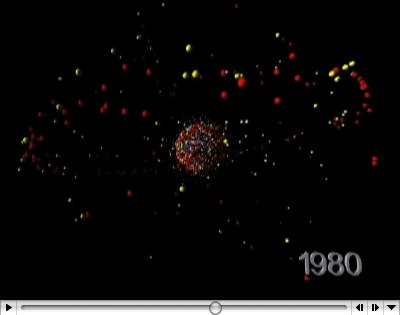
Sticking with the Space Debris theme, the ESA (European Space Agency) has this hi-res video on their website showing how crowded Earth orbit has become from 1968-2000.  Same issue as the image yesterday, that the objects are not to scale.  At this scale you would expect constant collisions, but at actual scale you wouldn't be able to see any objects at all.
In this animation, catalogued space debris are shown accumulating around Earth in 4-year increments, including payloads, rocket bodies, and fragments. While the debris objects are not shown to scale, the representation of their density is accurate.

Monday
Feb232009

Space Debris image


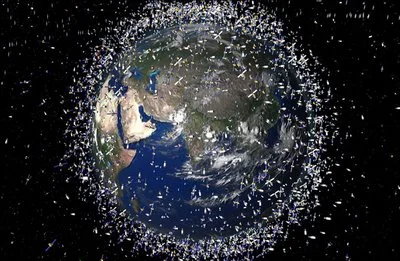
Great image from MSNBC PhotoBlog that tries to demonstrate how much space junk we have put into orbit around Earth.  I think the downside of this image is that the satellites aren't to scale.  If they were all this large, they would be running into each other all the time.

If you have Windows, you can see this high-res version with Microsoft HDView, but it doesn't work on a Mac.  I was able to see it with Parallels running on my MacBook.

A computer-generated artist's impression released by the European Space Agency (ESA) depicts an approximation of 12,000 objects in orbit around the Earth. A communications satellite belonging to US company Iridium collided with a defunct Russian military satellite on February 12, 2009.  (ESA via AFP - Getty Images/)
Thanks Karen for sending in the link!

Monday
Dec012008

Voyager Infographic video


Voyager from Jaime Arvizu on Vimeo.

Jaime Arvizu, a student at the Vancouver Film School, sent me a link to this infographic video that he and his team mates (Tyler Lemermeyer and Leo Aguiar) created for their Motion Design class.  You can find a high resolution version at Jaime's blog.

Thanks for sending this in Jaime, I love it!