About

Randy Krum infographic designerRandy Krum

President of InfoNewt.
Data Visualization, Infographic Design, Visual Thinking, Product Development and Marketing professional fascinated by good infographics.  Always looking for better ways to get the point across.

Infographic Design


InfoNewt Infographic Design

Search the Cool Infographics site

Custom Search


Subscriptions:


Feedburner

The Cool Infographics Gallery:

How to add the
Cool Infographics button to your:

Cool Infographics iOS icon

- iPhone
- iPad
- iPod Touch


Read on Flipboard for iPad and iPhone

Featured in the Tech & Science category

Flipboard icon

Twitter Feed
Caffeine Poster

The Caffeine Poster infographic

Google Insights

Entries in mergers (3)

Friday
Mar022012

The Genealogy of Automobile Companies 

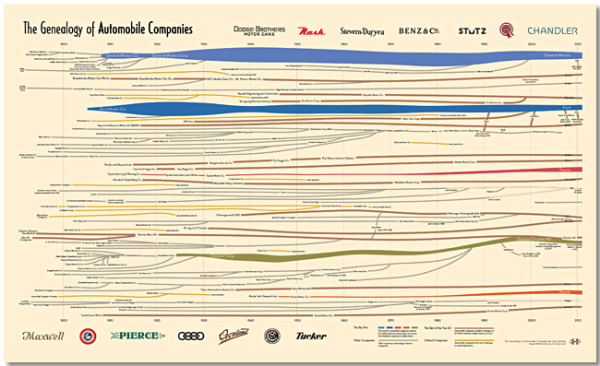
A brand new infographic poster designed by Larry Gormley at HistoryShots.comThe Genealogy of U.S. Automobile Companies visualizes over 100 years or corporate history of car company mergers, acquisitions and closures.

A flowing history of more than 100 automobile companies across the complete time span of the automobile industry. From 1900 to 1925 over 3,300 organizations were formed to produce automobiles in the United States. In 1910 alone 400 new startups entered the industry. Most attempts lasted less than two years. While car sales exploded (from 1910 to 2010 US sales rose from 200,000 to 11.5 million cars) the strongest entrepreneurs bought out rivals and combined forces. Today, ten companies account for about 90% of all US automobile sales.

This graphic uncovers and explains how the industry was created and how it arrived at its present form. At the core is a full genealogy of over 100 companies from the Big Five to the small defunct companies. Folded into the genealogy is the relative market share of US sales for each company.

The Big Five car companies have unique colors, and all of the other companies are color-coded into categories of he trest of the Top 20, defunct companies and other interesting or famous companies.  The thickness of the lines change over time to represent market share.

You can buy a copy of the 38” x 23” poster for $29.95 over at HistoryShots.com

Thanks to Larry for sending in the link!  Great design!

Wednesday
Sep212011

The Genealogy of U.S. Airlines


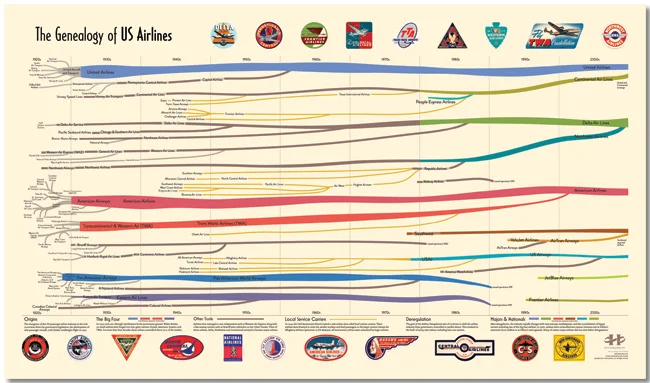
A new infographic poster designed by Larry Gormley at HistoryShots.comThe Genealogy of U.S. Airlines visualizes over 90 years or corporate history of airline mergers, acquisitions and closures.  Over 100 different airlines have consolidated down the seven shown still in existence today. 

The carriers are color coded and line widths represent market share for any particular year.

Over its short history, the US airline industry has experienced many dynamic phases of expansion and consolidation. From its origins in the 1920s, when air mail carriers started to transport passengers, to the creation (with the not so gentle prodding of the government) of the Big Four (American, United, TWA, and Eastern), from the rise of the local service carriers to deregulation and the most recent wave of mergers and acquisitions, the industry continues to fascinate both the casual traveler and the aviation buff.

The purpose of this graphic is to uncover and explain how the industry was created and how it arrived at its present form. At the core is a full genealogy of over 100 US airlines from the major airlines to the small local service carriers. Folded into the genealogy is the relative market share of passenger traffic for each airline. This allows the viewer to understand how the industry was controlled for many decades by the Big Four and how this dominance was quickly replaced by a number of other airlines.

You can buy a copy of the poster for $29.95 over at HistoryShots.com

Tuesday
Sep282010

Converging Flight Paths - Airline Merger Infographic

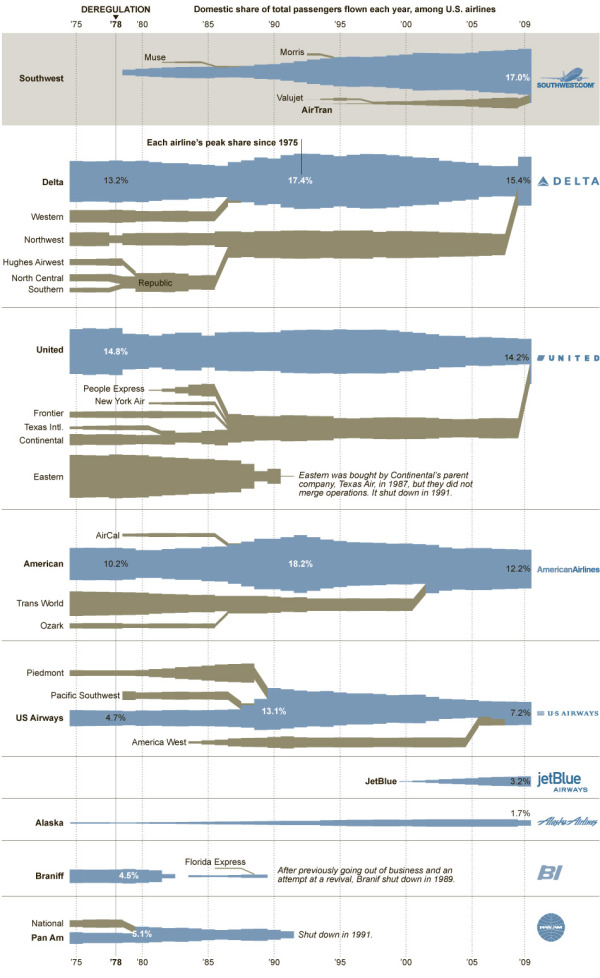
I really like this one from the NYTimes.com.  Converging Flight Paths visualizes the airline mergers over time from 1975 to today, but also shows the “Domestic share of total passengers flown each year.”

The deregulation of the airline industry in 1978 led to a wave of mergers that continues to this day. But even as the legacy carriers have been consolidating and growing, they have been losing market share to low-cost carriers. Two of them, SouthWest and AirTran, have just agreed to merge and carried the most domestic passengers in 2009 combined. But if international passengers were included, this ranking would be greatly rearranged.

By KARL RUSSELL/The New York Times.  Sources: American Transport Association (passenger data 1975-89); Bureau of Transportation Statistics (passenger data 1990-2009)

Link from Elliott Ng on Twitter.