About

Randy Krum

President of InfoNewt.
Data Visualization, Infographic Design, Visual Thinking, Product Development and Marketing professional fascinated by good infographics.  Always looking for better ways to get the point across.


Like us on Facebook to help spread the word!

Click +1 to give us your stamp of approval or just to say “this is pretty cool.”

Infographic Design


Search the Cool Infographics site

Custom Search

Design Contest!

Infographic Design Contest!

Enter to win an iPad 2!

Subscriptions:


How to add the
Cool Infographics button to your:

- iPhone
- iPad
- iPod Touch


Read on Flipboard for iPad and iPhone

Featured in the Tech & Science category

Strata Conference 2012

Follow Me!


Follow Randy (@rtkrum) 

Blog posts ONLY on Twitter

Twitter List: Cool Infographics People

Twitter Feed
Political Party Posters
2012 Death & Taxes Poster

Cool Affiliates

OmniGraffle

OmniGraffle for Mac - The Omni Group


Pixelmator

Pixelmator - Pixelmator Team


MindNode Pro

MindNode Pro - Markus Müller


 Skitch

Skitch - Skitch


GraphicConverter

GraphicConverter - Lemke Software GmbH


Visit Art.com


From the Bookstore

Caffeine Poster

Gadget Map

Google Insights

Infographics Carousel
Thanks to...
Powered by Squarespace


Entries in crime (5)

Friday
Oct212011

UN Against Corruption infographic video

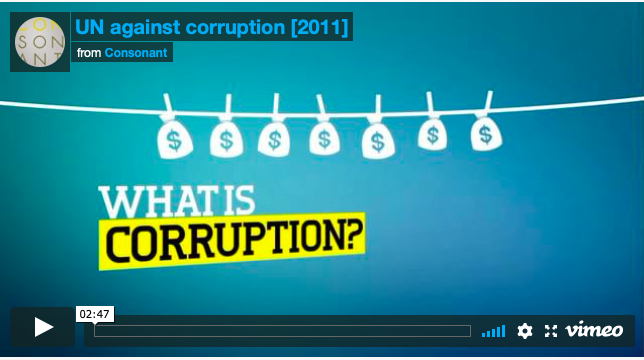
This UN Against Corruption infographic video is actually a highlights overview of a six-part video series from the UNCAC (UN Convention against Corruption) Coalition.  This video does a good job of showing how corruption impacts societies, escpecially in third world countries.  You can view the complete series at http://www.uncaccoalition.org/en/uncac-review/uncac-review-mechanism.html

Highlights of the six-part suite of 2D infographics videos commissioned by Transparency International in collaboration with UNODC. This video infographic uses animated typography and simple, iconic animated graphics and pictograms to explain the effects of corruption on society. It also incorporates a short segment of live-action video, embedded within the context of iconic elements. It provides a compelling and fast-paced tutorial for organisations and activists on how to bring pressure to bear on governments to more effectively fight corruption.

Credits:

  • art direction: mariano leotta
  • motion graphics: alessandra leone
  • sound design: ex-directory
  • sound mixing: enrico anicito guido
  • voice over: tom tucker
  • shooting: luca fuscaldi
  • production: artereazione.org
  • commission: transparency.org

The full six-part series is now available on YouTube:

Monday
Jun202011

Drunk Driving by the Numbers


The Real Effects of Drinking and Driving is a good infographic from CarInsuranceComparison.org.  It stays focused and tells one compelling story really well.  Some of the illustrations are just that, illustrations, when they could have visualized the numbers.

Thanks to Clyde for sending in the link!

Thursday
Aug262010

Client Infographic: Beware Work-At-Home Scams!

Beware Work-At-Home Scams is a recent project I did for elearners.com to visualize how prolific work-at-home scams are, which jobs to avoid and how individuals can protect themselves.

The data is actually fairly difficult to find and very dry.  I had to read through a number of reports from the FTC, the SBA, the IC3 (I had never heard of the Internet Crime Complaint Center!) and other news reports.  Even after reading through those reports, there was very little hard data.  To create the infographic, I needed to use the figure of Orange Man as a character figure to help visualize the information.


Done in OmniGraffle, I think the topic was a perfect example of when an infographic is really useful.  Information that is incredibly difficult for consumers to find (let alone understand), so it wouldn’t normally reach the general public.

Feedback?

You can help Digg It! 

Thursday
Sep172009

The History of Jack The Ripper (Infographic Poster)


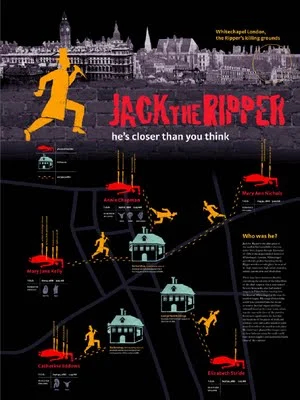
Ryan Nussbaum is a recent graduate of the design program at Washington University in St. Louis, and he created this infographic poster mapping out the murders of Jack the Ripper.

In this exhibition panel, I mapped the possible escape routes of a chief suspect in the Jack the Ripper murders. Upon closer examination, one can see the different types of wounds and removed organs of each of the victims. The piece is meant to dispel the notion that the murders were random occurrences.

Psst…Ryan is looking for work in New York…I’m just saying.


Wednesday
Sep162009

Oxford Crime Heatmaps from the BBC


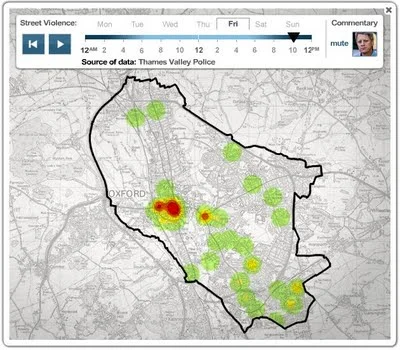
As part of the BBC launching thier new show called The Truth About Crime, they have launched a new "Crime Map" website that uses heatmaps to show real crime data for Oxford, England.  The heatmaps are visual representations of all the crime data available for the 12-month period from November 2007 to November 2008.

The website is designed to allow users to explore crime patterns, discover more about potential risks and take action to prevent crime.  The site features a specifically commissioned crime map of Oxford created with data supplied by the city's emergency services.

Why are you using heatmaps?
There are a number of methods for mapping crime. Currently, the technique most often used is to map crime data according to geographic areas such as postcodes, census output areas or police 'beat-codes'. The geographic areas chosen to map crime data – such as 'beat-codes' by the police – are often done so because these services deploy their resources according to their chosen geographical areas.
However, as these geographical areas vary greatly in size, when crime data is plotted on a map it is often difficult for a member of the general public to properly see and understand which areas have high or low crime rates. A large area may seem to have more crime than a small area even though this is simply because there is more space and people in that area. A small area with high crime might be hard to spot because it is simply physically smaller on the map, and therefore harder to see.
After extensive consultation with a host of experts in this specialist area, we have decided to use 'heatmaps' to display our crime data, since these offer a clear way for us all to see patterns of crime, without requiring us to have the expert knowledge of crime data analysts, nor a prior knowledge of arbitrary geographical areas. These 'heatmaps' represent the relative amount of crime according to a sliding scale of colour (as detailed in the "Key"), and provide a sense of the area where a type of crime is happening without disclosing the exact location that it took place – so as to protect the anonymity of victims
Heat maps such as these have not previously been used to any great extent in the UK, but have been used in the USA and Canada.
A number of different maps are available showing Crime Patterns Over Time, Burglary & Theft, Violent Crime, Anti-Social Behavior and the ability to compare to your own neighborhood (if you live in the U.K.)