About

Randy Krum infographic designerRandy Krum

President of InfoNewt.
Data Visualization, Infographic Design, Visual Thinking, Product Development and Marketing professional fascinated by good infographics.  Always looking for better ways to get the point across.

Infographic Design


InfoNewt Infographic Design

Search the Cool Infographics site

Custom Search


Subscriptions:


Feedburner

The Cool Infographics Gallery:

How to add the
Cool Infographics button to your:

Cool Infographics iOS icon

- iPhone
- iPad
- iPod Touch


Read on Flipboard for iPad and iPhone

Featured in the Tech & Science category

Flipboard icon

Twitter Feed
Caffeine Poster

The Caffeine Poster infographic

Google Insights

Entries in online (15)

Monday
Apr232012

The Rise of the Slacktivist 

Ever had this feeling that you were a Slacktivist? Well wonder no more! The Rise of the Slacktivist infographic from sortable.com will put a rest to all your questions!

Is there any value in a Slacktivist? Can 500,000 people on twitter actually change something? Is hitting the streets and protesting the only real way to cause social change? Sortable takes a look at the rise of slacktivism, and the power this movement has.

This design does a good job of telling a story to the reader that is easy to understand in a linear fashion top-to-bottom.  It starts with the background of “What is a Slacktivist,” then shares a number of behavioral stats about Slacktivists, a few successful Slacktavist campaigns and finally the “10 Signs you might be a Slacktivist” is a self-check for the readers.

The illustrations are mostly relevant, and the overall design isn’t too crowded with information.  I don’t understand some of uses of the social media icons, like why is Twitter representative of volunteering and Facebook representative of taking part in events?  They missed the opportunity to visualize some of their data point too, like the Red Cross stats related to the Haiti earthquake.  Even at least an illustration of five days on a calendar would help.

Even though there are a lot of Sources, they were thorough and correctly included them in the infographic design.  They are also listed on the landing page, but none of that text gets carried along when someone reposts the infographic.

The bottom of the design is missing a copyright statement, and it would be nice to give the designer credit.  Readers are generally more receptive to a design when the designer is mentioned because it comes from somebody and not just a corporation.

Thanks to Brenden for sending in the link!

Wednesday
May042011

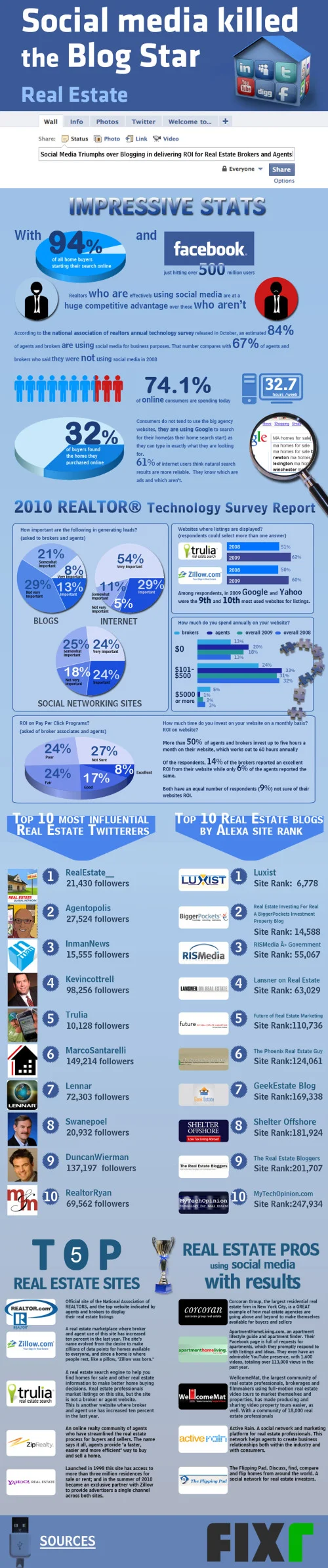
Real Estate: Social Media Killed the Blog Star


Another good infographic from Fixr.com about the how the real estate industry is changing.  Social Medai Killed the Blog Star: Real Estate looks at how buyers are finding their information online and who are the most influential blogs and real estate people on Twitter.

I like the use of company logos and Twitter profile images.  I also like that all of the data is built-in to the pie charts and bar charts to make it easier for the readers to comprehend.

The side-by-side Top 10 lists are interesting, but because they’re based on different measurements (followers vs. Alexa page rank), the graphic should give the reader some context of how to compare the different values.  Why do these lists support the overall message that social media is more important than blogging?

Some major technical errors as well.  Pie chart percentages should ALWAYS add up to 100%.  The pie charts here add up to 71%, 99%, 91% and 100%, which means that the visual of the slice sizes doesn’t match the data.  You never want your data visualizations to tell a story that isn’t supported by the data.

Thanks to Raul for sending in the link!

Wednesday
Apr202011

Social Media and College Admissions


Are colleges using social media as part of the student admissions process?  Schools.com explored this topic with the Reading Students like an Open Facebook infographic.  It’s hard enough to get teenagers to understand that online photos and status updates will be a permanent record of their behavior for the rest of their life, but even more immediately it could impact their entrance into college!

As Facebook has become more and more popular—if it were a country, it would be the third largest in the world—its use in the field of education has expanded, too. In fact, more than 80% of college admissions officers report using Facebook as part of their recruiting process. 

Are admissions officers really looking at the Facebook profiles of prospective students? And if so, are they making admissions decisions based on these profiles? Below is an infographic that highlights the answers to these questions and more—which might surprise you.

Thanks to Kristen for sending in the link!

Monday
Oct182010

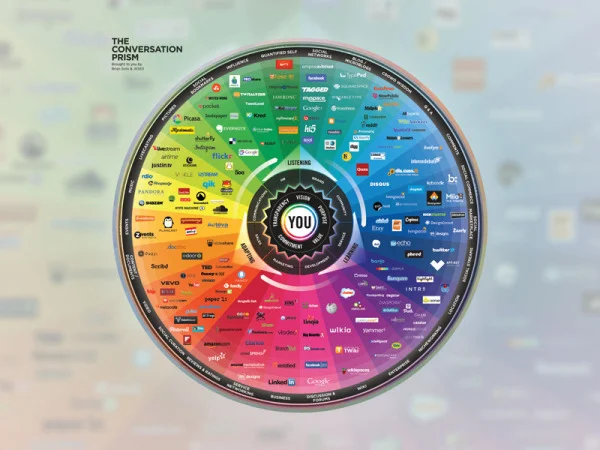
The Conversation Prism 3.0 for 2010

Brian Solis and JESS3 have released v3.0 of The Conversation Prism for 2010.  The Conversation Prism is a great infographic showing the major players in each of 28 different online conversation categories.  The original 1.0 version from August 2008 (image available on Flickr) only had 22 categories, and some of those only had one player.

You can buy the poster (I’ve got v2.0 hanging in my office) for $20, or there are also some great multi-pack deals for 3 posters for $40 or 4 posters for $50.

One of the best projects I’ve worked on is to use this idea to help companies map out their own corporate online strategy.  Which if these categories and tools are you trying to use to drive your business?  My advice, don’t try them all, be targeted about which ones are best to reach your target customers.  Use this as a guide, but make your own company-specific conversation prism.

Found on FastCoDesign by Cliff Kuang

Monday
Mar292010

Online Dating Is Bigger Than Porn [Infographic]

Online Dating Is Bigger Than Porn Infographic

New infographic, Ever Gotten A Date Online?, from OnlineSchools.org examining some of the data behind online dating.  As Mashable points out, one of the most surprising statistics is that the online dating industry is larger than the porn industry.

From Jennifer Van Grove at Mashable: Per the graphic — which pulls data from a number of sources, including Reuters and The Washington Post — online dating is worth more than one billion dollars per year, with the mobile phone dating market worth $550 million.

Found on Mashable via @hessiej on Twitter

Page 1 2