About

Randy Krum infographic designerRandy Krum

President of InfoNewt.
Data Visualization, Infographic Design, Visual Thinking, Product Development and Marketing professional fascinated by good infographics.  Always looking for better ways to get the point across.

Infographic Design


InfoNewt Infographic Design

Search the Cool Infographics site

Custom Search


Subscriptions:


Feedburner

The Cool Infographics Gallery:

How to add the
Cool Infographics button to your:

Cool Infographics iOS icon

- iPhone
- iPad
- iPod Touch


Read on Flipboard for iPad and iPhone

Featured in the Tech & Science category

Flipboard icon

Twitter Feed
Caffeine Poster

The Caffeine Poster infographic

Google Insights

Entries in connections (64)

Wednesday
Aug312011

Who Owns The Beer Brands?

That beer you’re drinking from that cool independent brewery may not be what you think.  Another very cool data visualization from Philip H. Howard and Ginger Ogilvie at Michigan State University called Concentration in the US Beer Industry.  Similar to their last project visualizing the soft drink industry in The Illusion of Diversity, this new project shows the breweries and individual beers owned by the top 13 companies.

There is an appearance of great diversity in the number of brands and varieties of beer sold in the United States. The beer industry, however, is dominated by a relatively small number of firms.

AB InBev owns, co-owns or distributes more than 36 brands, for example, while MillerCoors controls at least 24 more. MillerCoors also brews Metropoulos & Company’s products under contract (thus the company that controls Pabst and 21 other brands is a “virtual” beer company).

Only meant to show which companies own which beer brands, the three bubble sizes are used to show parent companies, brewery brands and individual beer brands.  They designed a separate treemap visualization to show market share.

Because these are large visualizations, they have posted them within zooming viewers on the Michigan State University site.

Found on Flowing Data.

Wednesday
Jul272011

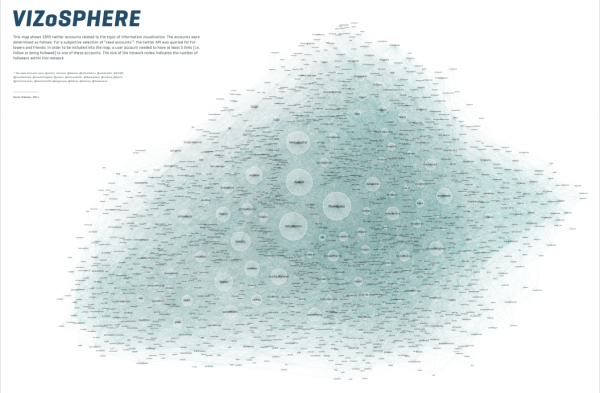
The VIZoSPHERE - Visualizing DataViz People on Twitter

From Moritz Stefaner on Visualizing.org, comes the VIZoSPHERE project (Click the image to see the high-resolution image viewer).  Using GePhi, Moritz started with 18 seed accounts on Twitter, and then mapped 1,645 of the connected, networked accounts that relate to data visualization.  Bubble size in this visualization shows how many followers each account has from within this DataViz pool of users.

This map shows 1645 twitter accounts related to the topic of information visualization. The accounts were determined as follows: For a subjective selection of “seed accounts”[1], the twitter API was queried for followers and friends. In order to be included into the map, a user account needed to have at least 5 links (i.e. follow or being followed) to one of these accounts. The size of the network nodes indicates the number of followers within this network.


[1] The seed accounts were; @moritz_stefaner, @datavis, @infosthetics, @wiederkehr, @FILWD, @janwillemtulp, @visualisingdata, @jcukier, @mccandelish, @flowingdata, @mslima, @blprnt, @pitchinteractiv, @bestiario140, @eagereyes, @feltron, @stamen, @thewhyaxis

The zooming interface is crucial to view such a highly-detailed visualization and be able to read any of the nodes.  I was about to find my own Twitter account (@rtkrum), but it would be nice if Moritz would also provide a listing of the Twitter accounts or some way to search the map.

Great job Moritz!

Found on FlowingData and Robin Richards (@ripetungi) on Twitter.

Friday
Jan282011

InMaps: Viewing Your Business Network

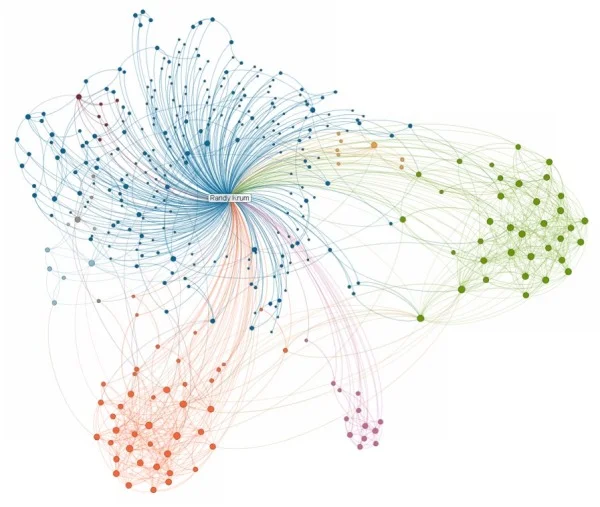
The new LinkedIN Maps is a very cool interactive infographic that visualizes your own LinkedIN network.  The InMaps pull data from your own LinkedIN profile when you allow access, so you can only see your own network.  

The connections are grouped into clusters based on shared connections and companies.  You can see above that my network has a few clearly defined clusters, but then a large blue area that has no clear cluster information.  You can also learn about you network with some of the visual data built into the map.  People with bigger dots and their names in larger fonts have more connections.

It’s interactive, so you can zoom in to see the individual names, and if you click on a connection, it highlights all of their connections as well.

Check out the quick, descriptive video from LinkedIn’s chief scientist DJ Patil:


For some reason, it doesn’t show every connection between people.  There are a few people in my network that I know are also connected to each other; however, the map didn’t show any connection between them.  Not sure what’s going behind the scenes.

You can publicly share your map on Twitter, Facebook and of course LinkedIN when you click the share buttons.  Here’s mine.  This creates a static image with a legend if you have named your color-coded clusters.  Clicking on the map takes readers to the front page to create their own, but clicking on your name takes them to your LinkedIN profile page.

You can also see some other anonymous maps on the front page by clicking on the “Next Map” button which will change to the background map image.

This one has been popular.  Found on FlowingDataVizWorld, Infosthetics and Mashable.

Thursday
Jan202011

The Illusion of Diversity: Visualizing the Soft Drink Industry


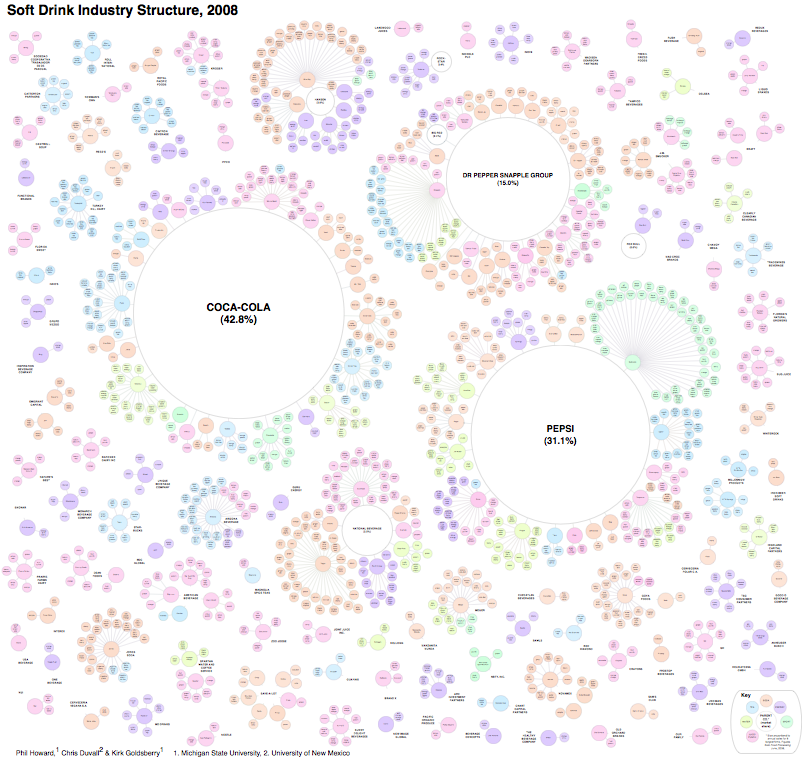
Very cool visualization from Philip H. Howard at Michigan State University called The Illusion of Diversity.  It’s fairly big and hard to read, so I dropped the image link into Zoom.it to create the zoomable image above.  You can see the high-resolution image here, or download the high-resolution PDF here.

Background
Three firms control 89% of US soft drink sales [1]. This dominance is obscured from us by the appearance of numerous choices on retailer shelves. Steve Hannaford refers to this as “pseudovariety,” or the illusion of diversity, concealing a lack of real choice [2]. To visualize the extent of pseudovariety in this industry we developed a cluster diagram to represent the number of soft drink brands and varieties found in the refrigerator cases of 94 Michigan retailers, along with their ownership and/or licensing connections.

Professor Howard’s team did a lot of legwork visiting stores to gather the data, recording 987 different varieties of soft drinks from 94 food retailers in the Lansing, Michigan area.


The statement “Three firms control 89% of US soft drink sales” really means that “89% of the drinks available come from only three firms”.  The distinction is subtle, but there is no sales data included.  This is just an ownership structure.

You also have pay attention to what you’re seeing.  The bubble sizes are mixed because the parent company bubbles are sized to the portion of drinks they control, but the size of the individual drink bubbles is consistent and doesn’t convey any meaning.  For the individual drink, the color-coding is what conveys meaning.

Conclusion
The illusion of diversity in the soft drink industry extends beyond obscuring ownership, as its products are primarily water and sweeteners. More research is needed on the links between pseudovariety and the consumption of energy-dense, nutrient-poor substances.

I noticed that this was created using OmniGraffle, which is a vector mapping application that I use a lot.

Found on Infosthetics.com and VizWolrd.com 

Tuesday
Jan182011

The X-Men Family Tree #infographic


Joe Stone just posted his design of the X-Men Family Tree.  Connection lines styles and colors reveal the type of relationship.  Silhouettes or minimal illustrations give the reader just enough visual cues to identify each of the mutants.  How many can you identify?

A little Illustrator-drawn infographic I’ve been playing around with. I probably could have included more characters, but I had to draw the line somewhere.

Joe has also made a high-resolution version available for anyone that wants to print it out!  Thanks Joe!

Wednesday
Oct132010

More Lawsuits in the Mobile Business

George Kokkinidis from Design Language News made another great infographic redesign of the Lawsuits in the Mobile Business.  A significant improvement over the original diagrams in The Guardian and the NYTimes.

An attempt at redesigning this chart from The Guardian to make the plaintiffs and defendants a bit more clear.

Although this doesn’t add the additional data dimensions of company revenues like “Who’s Suing Whom?”, this diagram is much easier to read and understand than the originals.

Great job George, and thanks for the link!

Wednesday
Oct062010

Who’s Suing Whom: Lawsuits In The Telecoms Trade infographic


Who’s Suing Whom is a great infographic design improvement by David McCandless from InformationIsBeautiful.net.  David took existing diagrams (which were pretty poor) from The Guardian and the NY Times, and created a much more compelling and information-rich infographic.  My feeling from the news is that there are many more lawsuits that these, but I don’t know the data.

Based on these diagrams from Guardian Tech and the NY Times.

I thought those charts generated more questions than they answered. So, as ever, I tried to answer the obvious questions and convey various contexts simultaneously.

I wondered, too, if I could design the connections so the lines didn’t cross. Almost managed it!

And see if there was a relationship between dropping revenues and litigiousness. What do you think? Is there?

Data: http://bit.ly/sosueme


Great job David!

Tuesday
Sep282010

The Display Ad Tech Landscape


Developed by Terence Kawaja of LUMA Partners, the Display Advertising Technology Landscape makes an attempt to map out the companies involved in this ever-changing business.  This is his latest version, but even he admits that his chart is far from perfect.

By definition the chart will never be final since the space is so dynamic. I am still discovering companies.

A few things to bear in mind. This chart is far from perfect. Organization of such a fragmented and dynamic industry is flawed by its very nature. Many companies operate across several categories and there are distinctions within categories. This chart does not include many of the search players which are increasingly overlapping with display nor does it reflect whole categories such as lead generation and ecommerce which likewise utilize display advertising in their funnel, not to mention international companies which are barely reflected. At some point in the future I may construct an uber landscape which captures these and other players.

I believe we are in for some interesting times as the space rationalizes and consolidates along with the advent of new strategic entrants.

I applaud Terence in his attempt to visualize this complicated business environment that he works with.  Even if it’s not perfect, it certainly helps readers understand this business better by making it visual.  You certainly don’t have to be a graphic artist to make useful infographic, and I think Terrance has made a step in the right direction.  I look forward to seeing future versions.

Found on AllThingsD.com and AdExchanger.com

Wednesday
Sep082010

The Most Widely Spoken Languages of the World

A subway map style infographic, The Most Widely Spoken Languages of the World, shows some of the primary countries and the languages they speak.  Each track is a different language, and the connection point are countries where that language is one of the dominant languages.  The actual number estimates behind how many people speak each of the top languages is listed in the legend.

I don’t know how accurate it is because the data source isn’t listed.  I would think that the U.S. would at least be a junction point between English and Spanish (and maybe others).

This infographic illustrates the most widely spoken languages in the world and some of the countries these languages are spoken in.  The station name indicates the language and the number of speakers that languages has and the map illustrates some of the countries these languages are spoken in.  The list of countries is not exhaustive but can help the viewer navigate the world of languages.
The inspiration for this map came from the London Underground map – which in fact is not a map but a schematic diagram. As a schematic diagram it shows not the geographic but the relative positions of stations along the lines, stations’ connective relations with each other and their fare zone locations.

This infographic has been commissioned by PS Translation to showcase their range of
translation services.

I also think this is a fantastic example of a infographic used for marketing purposes.  It’s not an outright advertisement, but it is certainly a related topic to a translation service done in a very appealing design style.

Thanks for the link James!

Monday
Aug022010

Automotive Family Tree: Update, Interview and Poster GIVEAWAY! #autotree

Andy Harris from TooManyCars.info has updated (a few times) his fantastic Automotive Family Tree map of who owns the car companies since the last time I posted about it a couple years ago.  The map is so big and detailed that you have to click on specific ownership corporations to zoom into just their connections.  The colored connection lines indicate the nature of each relationship (Joint Venture, License, Ownership or Sharing Technology).


You can enter to win a FREE copy of the printed poster by tweeting a link to this post on Twitter including the hashtag “#autotree” (without the quotes) by the end of the day on August 6th.  I’ve included the hashtag in the title, so you can enter by retweeting the post from my Twitter account.  One winner will be randomly chosen to receive a printed copy of the poster.  You have to be following me on Twitter so I can send you a direct message if you win.

The large version is available for a small donation to TooManyCars.info.  The PDF is available for $5, and the 36”x36” printed poster is available for $30.

Andy also agreed to answer a few interview questions about how he makes the Automotive Family Tree and it’s history.

Cool Infographics: What inspired you to create the Automotive Family Tree?

Andy Harris: About 8-10 years ago in a British auto magazine I saw a diagram showing the main connections between automotive manufactures (Ford owns Lincoln, GM owns Chevy, etc.). The more I thought about the diagram, the more info I wanted to know. I decided I want to learn HTML so I used the idea of the Automotive Family Tree as my learning curve.   


Cool Infographics: Do you do all of the design yourself?  What’s your background?

Andy Harris: I do all the design for the website and Automotive Family Tree myself. My day job is telecommunications engineering, however my background is in CAD. Bottom line, I draw maps showing where the telephone cable in the alley is located, type of cable, electronics, etc. I never really consider myself a design artist.   


Cool Infographics: What software applications do you use for the family tree?

Andy Harris: Because of my background in CAD, the large PDF is made using AutoCAD. But the smaller diagram for the website is done in OmniGraffle. So, my MacBook Air gets a work out switching between XP to use AutoCAD and OS X to use OmniGraffle.


Cool Infographics: How much traffic does having the infographic drive to your site, TooManyCars.info?

Andy Harris: When I first started my website, it was about car reviews. Then I switched to blogging a few years back. But the heart of my website has always been the Automotive Family Tree. This infographic is a major reason someone comes to my blog.


Cool Infographics: Are there any interesting places you know the poster is being displayed?

Andy Harris: The most interesting printed posted I sold to was someone in Russia and Turkey. My download PDF has also been sold around the world. But the most interesting request for the Automotive Family Tree was used in a Master Thesis from a student in Poland. However, one thing I’m proud of is being published in GQ magazine from Taiwan. The automotive industry is truly international!


Cool Infographics: What are some of the most surprising or interesting company relationships you’ve found by doing the family tree?

Andy Harris: I think the most surprising relationship in the family tree is the amount of change. There are joint-ventures everywhere because of the economy, and more and more sharing of technology between manufactures, making some strange bed-fellows. I’d say the new Renault-Mercedes-Benz connection is the most surprising.


Cool Infographics: How difficult is it to gather the company relationship data?

Andy Harris: I get this question many times, how long did it take you to make this? I really don’t like to think about it, but if I had to guess, 120 + hours in just gathering information, reconfirming, gathering more information, more confirmation and still gathering more information. I’ve recreated it two times. My first example was more simple and just using the major automotive manufactures from USA, Euro and Asia. Then as China grew, I added more automotive logos, more gathering of information and reconfirming. I’m not sure if it was difficult as much as time consuming. But putting this together became a labor of love.


Cool Infographics: What are the printing specs for the poster and why?

Andy Harris: I currently print at 36”x36”, I started as D-size or 24”x36”. As it grew 36”x36” was the most logical choice and the square print looks nice.


Cool Infographics: What’s the most interesting part of designing the Automotive Family Tree?

Andy Harris: I think one of the most interesting parts about the Automotive Family Tree, is the different types of people wanting to download the PDF. I’ve got request from a F1 engineering group, NUMMI manufacture marketing (before they closed), trading companies, automotive equipment manufacturers and oil companies. But not the petrol makers, think more like lubrications for engines and lubricants for manufacturing equipment. When I started this journey, I only wanted to inform the public that the automotive world is truly international, and now I get emails asking me to add more specialty manufacturers or even make custom inforgraphics.

Great job Andy!